Conversational AI is transforming how people interact with technology, turning rigid menus and forms into natural, human-like conversations. Learning what is conversational AI helps businesses understand how intelligent systems can improve communication across channels. From chatbots on websites to voice assistants in smart devices, it quietly reshapes customer service, sales, and daily operations.
With Virtual Agent Assist, companies can efficiently scale support, reduce response times, and improve customer satisfaction, showing clearly why virtual agent assist is essential for scaling customer support. By integrating these tools, teams can focus on complex tasks while AI handles repetitive queries, boosting efficiency and morale.
Virtual Agent Assist transforms customer experience by making interactions faster, smarter, and more personalized. Companies exploring the technology can see practical applications in action by visiting FlashMob Computing’s AI resources, which highlight advanced conversational systems. For more technical insights, Supercomputer Box dives into the architecture behind intelligent virtual agents.
Businesses looking to combine AI with marketing strategies can learn about AI-powered customer engagement solutions, which show how automated conversations drive real results. Similarly, Marketing Runners’ guide to AI in marketing campaigns explains step-by-step how virtual agents improve interaction quality.
Even financial services benefit from conversational AI, as seen in Top Financial Resources’ insights on AI applications in finance, demonstrating cost savings and smarter client support. Companies of all sizes can adopt these strategies to enhance customer experience and gain a competitive edge.
This guide explains what conversational AI is, how it works in plain language, and how businesses of all sizes can use it to boost satisfaction, lower costs, and unlock new opportunities.
Top 10 Contact Center Solutions Powered by AI
If you are exploring what is conversational AI, it’s essential to know which platforms are leading the way in AI-driven customer support. These contact center solutions combine automation, intelligent routing, and virtual assistants to improve efficiency, reduce response times, and enhance the customer experience. Here’s a list of the top providers, starting with Bright Pattern.
1. Bright Pattern – AI Contact Center Solutions
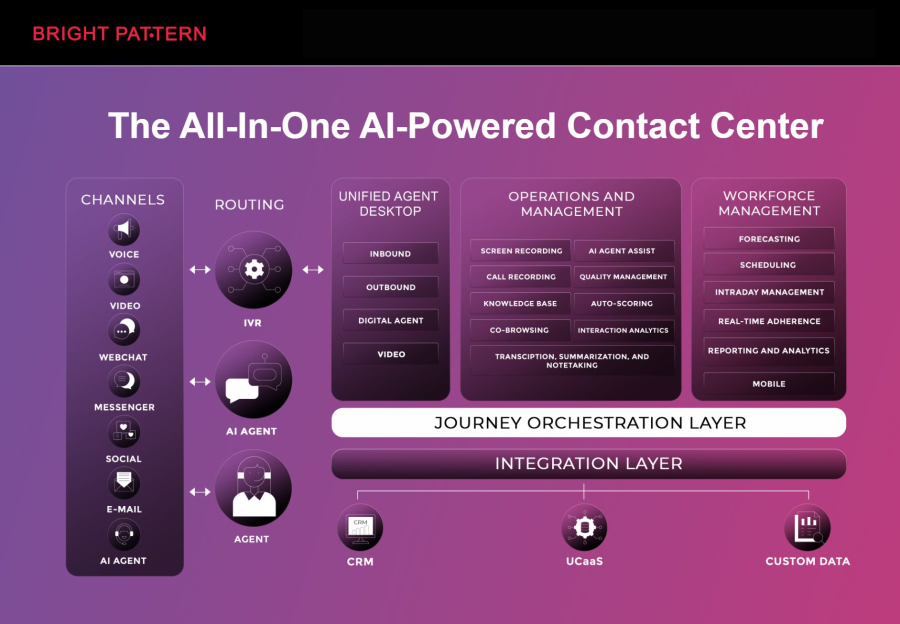 Bright Pattern offers a comprehensive AI-powered contact center platform that helps organizations transform their customer service operations. With advanced conversational AI, Bright Pattern enables natural, human-like interactions across multiple channels including voice, chat, email, and social media.
Key features of Bright Pattern include:
- AI-driven chatbots and virtual assistants for instant support
- Omnichannel communication for seamless customer experiences
- Intelligent routing to connect customers to the right agent faster
- Analytics and reporting for performance optimization
- Integration with CRM systems and business applications
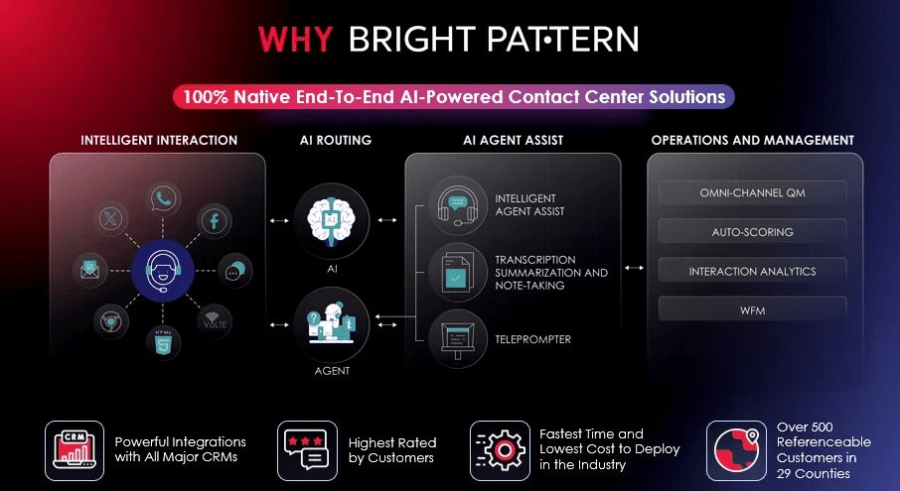
Bright Pattern is particularly recognized for its easy deployment, scalable architecture, and ability to enhance both agent and customer experiences. Companies using Bright Pattern can reduce operational costs while maintaining high-quality service.
2. Genesys Cloud CX
Genesys Cloud CX provides AI-powered routing, predictive analytics, and conversational AI tools to help businesses deliver personalized customer experiences. Its platform supports multiple channels and offers tools for workforce optimization.
3. Five9 Intelligent Cloud Contact Center
Five9 combines AI with cloud-based contact center solutions, offering virtual agents, speech analytics, and intelligent routing to streamline customer interactions.
4. NICE inContact CXone
CXone uses conversational AI to improve customer engagement, providing predictive analytics, omnichannel routing, and AI-powered virtual assistants.
5. Talkdesk CX Cloud
Talkdesk CX Cloud delivers AI-enhanced contact center solutions with features like automated workflows, smart IVR, and sentiment analysis to improve agent efficiency.
6. RingCentral Contact Center
RingCentral integrates AI into its contact center solution, offering tools like virtual agents, automated call distribution, and real-time analytics for better customer service.
7. Cisco Contact Center
Cisco’s AI-powered contact center focuses on multichannel support, predictive routing, and advanced reporting to optimize both agent and customer experiences.
8. 8x8 Contact Center
8x8 provides cloud-based AI contact center solutions with virtual assistants, automated workflows, and analytics to help organizations streamline operations.
9. Zendesk Sunshine Conversations
Zendesk uses AI and automation to enhance customer communication across messaging apps, web chat, and email, creating a unified and intelligent support experience.
10. Amazon Connect
Amazon Connect is a cloud-based contact center service that leverages AI and machine learning for intelligent routing, chatbots, and real-time analytics to enhance customer interactions.
Conversational AI: A Simple Definition
Conversational AIis a set of technologies that allow computers to understand, process, and respond to human language in a natural, conversational way. It powers tools such as chatbots, virtual assistants, and voice interfaces that can talk or chat with users in real time.
At its core, conversational AI aims to make interacting with software feel less like using a machine and more like having a helpful conversation with a knowledgeable assistant.
How Conversational AI Differs From Traditional Chatbots
Not every chatbot is truly conversational AI. Older or rule-based systems follow simple, pre-programmed scripts. They can respond only when users type specific keywords or click fixed buttons.
Conversational AI systems are more advanced.They use artificial intelligence to interpret meaning, handle variations in language, and adapt to user context. Instead of matching exact phrases, they focus onintent— what the user actually wants to achieve.
Rule-Based Chatbot vs. Conversational AI
|
Aspect |
Rule-Based Chatbot |
Conversational AI |
|
Language handling |
Depends on fixed rules and keywords |
Understands varied phrasing and natural language |
|
Flexibility |
Breaks when users deviate from scripts |
Can clarify, ask follow-up questions, and adapt |
|
Learning ability |
Needs manual updates for new use cases |
Improves over time with data and training |
|
User experience |
Feels mechanical and limited |
Feels more natural, responsive, and helpful |
Key Technologies Behind Conversational AI
Although conversational AI can seem magical, it is powered by several well-understood technologies working together.
1. Natural Language Understanding (NLU)
Natural Language Understandingis the part of conversational AI that interprets what the user means. It takes raw text or speech and turns it into structured information a system can act on.
NLU focuses on tasks like:
- Intent detection— identifying what the user wants to accomplish, such as"reset password"or"check order status".
- Entity extraction— pulling out key details, such as names, dates, order numbers, or locations.
- Sentiment analysis— recognizing whether the user is frustrated, satisfied, or neutral, so responses can be adjusted.
2. Natural Language Generation (NLG)
Natural Language Generationis the reverse process: it takes structured data or decisions and turns them into human-readable text. NLG allows conversational AI to respond in clear, fluid sentences instead of robotic fragments.
Good NLG results in responses that are:
- Concise— answering the question directly.
- Context-aware— taking into account what has already been said.
- Consistent— matching your brand voice and tone.
3. Automatic Speech Recognition (ASR) and Text-to-Speech (TTS)
For voice-based experiences, conversational AI also uses:
- Automatic Speech Recognition(ASR) to convert spoken language into text the system can understand.
- Text-to-Speech(TTS) to convert text responses back into natural-sounding speech.
Together, ASR and TTS allow users to interact hands-free, simply by speaking, which is especially valuable in cars, call centers, smart homes, and on-the-go scenarios.
4. Machine Learning and Large Language Models
Machine learningenables conversational AI systems to improve over time. By learning from past interactions and feedback, they refine their ability to understand user intents, recommend relevant answers, and handle new ways of asking the same question.
In many modern solutions,large language modelshelp generate more natural and contextually appropriate responses, especially in open-ended or complex conversations.
Types of Conversational AI Solutions
Conversational AI appears in many forms across digital channels. Here are some of the most common types businesses deploy.
1. Chatbots
Chatbotsare text-based assistants that interact with users in messaging windows on websites, apps, and chat platforms. They can handle tasks such as answering FAQs, collecting information, routing queries, and initiating transactions.
Advanced chatbots use conversational AI to understand varied phrasing, support multi-turn conversations, and escalate to human agents when necessary.
2. Virtual Assistants
Virtual assistantsare broader, more general-purpose conversational agents. They can be embedded in devices, productivity tools, or business workflows to help with reminders, scheduling, search, and task automation.
In a business context, virtual assistants can support employees by surfacing information, summarizing content, and guiding them through complex procedures in real time.
3. Voice Assistants and Voice Bots
Voice assistantsandvoice botsenable users to interact using speech instead of typing. They are common in smart speakers, mobile devices, and interactive voice response (IVR) systems in call centers.
Voice-based conversational AI reduces friction: users can simply speak naturally, which is faster and more convenient in many scenarios.
4. AI-Powered IVR in Contact Centers
Modern contact centers use conversational AI to upgrade traditional IVR menus. Instead of pressing numbers to navigate a maze of options, callers can simply say what they need in their own words.
This leads to:
- Shorter call times.
- More accurate routing.
- Higher satisfaction for both customers and agents.
What Can Conversational AI Do?
Conversational AI can support a wide range of customer and employee journeys. Its flexibility allows organizations to start small and expand over time.
Customer-Facing Use Cases
- Customer support— answering common questions, troubleshooting simple issues, and providing step-by-step guidance.
- Order tracking— checking delivery status, updating shipping details, or confirming appointments.
- Sales assistance— recommending products, explaining features, and helping customers compare options.
- Account management— resetting passwords, updating personal data, or reviewing subscription details.
- Booking and reservations— scheduling visits, booking tables, or changing appointments without waiting on hold.
Internal and Employee Use Cases
- IT helpdesk automation— guiding employees through common device and software issues.
- HR self-service— answering questions about policies, benefits, and leave balances.
- Onboarding support— helping new employees find resources and complete required steps.
- Knowledge access— allowing staff to ask natural-language questions about processes, products, or documentation.
Benefits of Conversational AI for Organizations
When implemented thoughtfully, conversational AI delivers value across customer experience, operations, and revenue.
1. Improved Customer Experience
Customers increasingly expect quick, convenient, and personalized support. Conversational AI helps meet those expectations by providing:
- 24/7 availability— always-on help, even outside business hours or during peak times.
- Instant responses— no hold music, queues, or waiting for email replies.
- Consistent answers— accurate and up-to-date information based on your latest knowledge base.
- Personalized interactions— context-aware conversations that remember preferences and history where appropriate.
2. Greater Efficiency and Cost Savings
Conversational AI can handle a high volume of routine inquiries, taking pressure off human teams and optimizing operational costs.
- Deflects repetitive questionsso agents can focus on complex or high-value cases.
- Reduces average handling timeby collecting information before handing over to a human.
- Scales effortlesslyto handle spikes in demand without hiring surges.
The result is a more efficient operation and a better use of human expertise where it truly matters.
3. Better Data for Decision-Making
Every conversation is a source of insight. Conversational AI can automatically capture and aggregate interaction data, helping you understand:
- Which questions customers ask most often.
- Where users get stuck in your processes.
- Common reasons for churn, complaints, or confusion.
This makes it easier to improve products, refine documentation, and redesign journeys based on real behavioral patterns.
4. Enhanced Employee Experience
Employees also benefit when conversational AI takes care of repetitive queries and tedious look-ups. With AI handling routine tasks, teams can:
- Spend more time on meaningful, complex work.
- Access answers quickly without digging through documents.
- Onboard faster by asking natural questions as they learn.
How a Typical Conversational AI Interaction Works
Although the underlying technology is sophisticated, a typical interaction follows a simple flow.
- User input— a person types or speaks a message.
- Pre-processing— the system cleans and normalizes the text (or converts speech to text).
- NLU analysis— the system identifies the intent and extracts relevant entities.
- Decision and action— based on business rules, data, and context, it decides how to respond or which action to take.
- Response generation— NLG creates a natural-language answer, which may include follow-up questions.
- Delivery— the response is sent as text or converted into speech for the user.
- Learning— over time, the system can use feedback and outcomes to improve.
Core Capabilities to Look for in Conversational AI
When evaluating or designing conversational AI, some capabilities make the difference between a basic bot and a high-performing assistant.
- Multi-turn conversation handling— the ability to manage back-and-forth dialogues, ask clarifying questions, and maintain context.
- Context and memory— understanding what was said earlier in the conversation to avoid repetitive questions.
- Omnichannel support— a consistent conversational experience across web chat, mobile apps, messaging platforms, email, and voice.
- Integration with business systems— connecting to CRMs, ticketing tools, order systems, and knowledge bases to take action and provide accurate answers.
- Secure and compliant handling of data— protecting user information and complying with relevant privacy and security regulations.
Implementing Conversational AI: From Idea to Launch
Successful conversational AI projects follow a structured approach. The aim is to start with clear, focused goals and then grow as you learn from real interactions.
1. Define Goals and Use Cases
Begin by clarifying what you want conversational AI to achieve. For example:
- Reduce support tickets for simple questions.
- Shorten customer wait times in your contact center.
- Increase self-service adoption for account management.
- Help employees find internal information faster.
Then identifyspecific, high-impact use caseswhere conversational AI can make an immediate difference.
2. Map User Journeys and Dialog Flows
Next, design how conversations should flow. Consider:
- How users naturally phrase their questions.
- What information the AI must collect to solve an issue.
- Clear paths to escalate to a human agent when necessary.
Well-designed dialog flows keep conversations efficient, friendly, and focused on outcomes.
3. Connect to Data and Systems
To go beyond simple FAQs, conversational AI needs access to relevant information. Typical integrations include:
- Customer relationship management systems for profiles and history.
- Knowledge bases and documentation for answers and guides.
- Order or booking systems to check statuses or update records.
These connections allow the AI to carry out tasks, not just provide information.
4. Train, Test, and Refine
Training conversational AI involves feeding it example interactions, testing how well it understands user intents, and refining based on gaps.
- Start with the most frequent questions and scenarios.
- Use sample phrases from real customers when possible.
- Monitor misinterpretations and update training data regularly.
Iterative improvement is essential: the AI becomes more accurate, helpful, and efficient as you continue to refine it.
5. Launch Gradually and Monitor
Many organizations find success with a phased rollout. For example:
- Start on a single channel, such as website chat.
- Handle a limited set of topics initially.
- Monitor satisfaction, resolution rates, and escalation volume.
- Expand coverage and channels as performance improves.
Best Practices for Effective Conversational AI
To maximize the benefits of conversational AI, consider these practical guidelines.
1. Be Transparent With Users
Make it clear when users are interacting with an AI assistant. Transparency helps build trust and sets expectations.
You can do this by:
- Giving the assistant a clear name and short introduction.
- Explaining what it can help with right at the start.
- Offering a simple way to reach a human when needed.
2. Design for Clarity and Brevity
Good conversational AI responds in short, easy-to-digest messages. Avoid long paragraphs of text and keep each reply focused on moving the user toward a solution.
- Ask one question at a time.
- Summarize options clearly.
- Confirm key details before taking important actions.
3. Build Strong Escalation Paths
Even the best AI will not resolve every issue. Make escalation to human agents seamless, especially for complex, emotional, or high-value interactions.
- Transfer conversation history so users do not need to repeat themselves.
- Let users request a human at any point.
- Prioritize escalations when the AI detects frustration or confusion.
4. Continuously Improve With Real Data
Treat conversational AI as a living system. Use real interaction data to improve over time.
- Identify new topics and questions that appear frequently.
- Refine training data where the AI struggles.
- Adjust dialog flows based on user behavior and feedback.
5. Align With Brand Voice and Values
Your AI assistant is often the first touchpoint for customers. Ensure it reflects your brand’s personality and standards.
- Define a consistent tone: friendly, professional, or a mix that fits your brand.
- Set clear guidelines for politeness, empathy, and clarity.
- Ensure responses align with your company values, especially on sensitive topics.
The Future of Conversational AI
Conversational AI continues to advance rapidly. Systems are becoming better at understanding context, managing complex conversations, and cooperating with other tools to complete tasks.
Emerging trends include:
- More human-like interactionsthanks to advances in language models and speech technologies.
- Deeper personalizationusing consent-based data and preferences to tailor experiences.
- Expanded use inside organizationsto assist employees across departments and roles.
For organizations, this evolution creates an opportunity: those who invest early and thoughtfully in conversational AI can streamline operations, delight customers, and stand out in competitive markets.
Key Takeaways
- Conversational AIenables computers to communicate with people in natural language through chat or voice.
- It goes beyond simple rule-based bots by using AI to understand intent, maintain context, and generate helpful responses.
- Common applications include customer support, sales assistance, internal helpdesks, and AI-powered IVR in contact centers.
- Benefits range from improved customer experience and faster service to operational efficiency and richer data insights.
- Success depends on clear goals, thoughtful design, strong integrations, and continuous improvement.
Ultimately, conversational AI is not just about automating responses. It is about creating smoother, smarter, and more human experiences whenever people interact with your organization.
